 English
 русский
 عربى
عربى

A MIG wire plant spent six months chasing a 4% reject rate on ER70S-6 spools. Customer complaints pointed to erratic arc stability, yet the chemistry of every heat sat inside certificate limits. The fault was finally traced to diameter variation: the wire drifted by ±0.04 mm across a 15 kg spool, disturbing contact tip grip and feed speed. The fix had nothing to do with steel quality. It came from the machine doing the pulling.
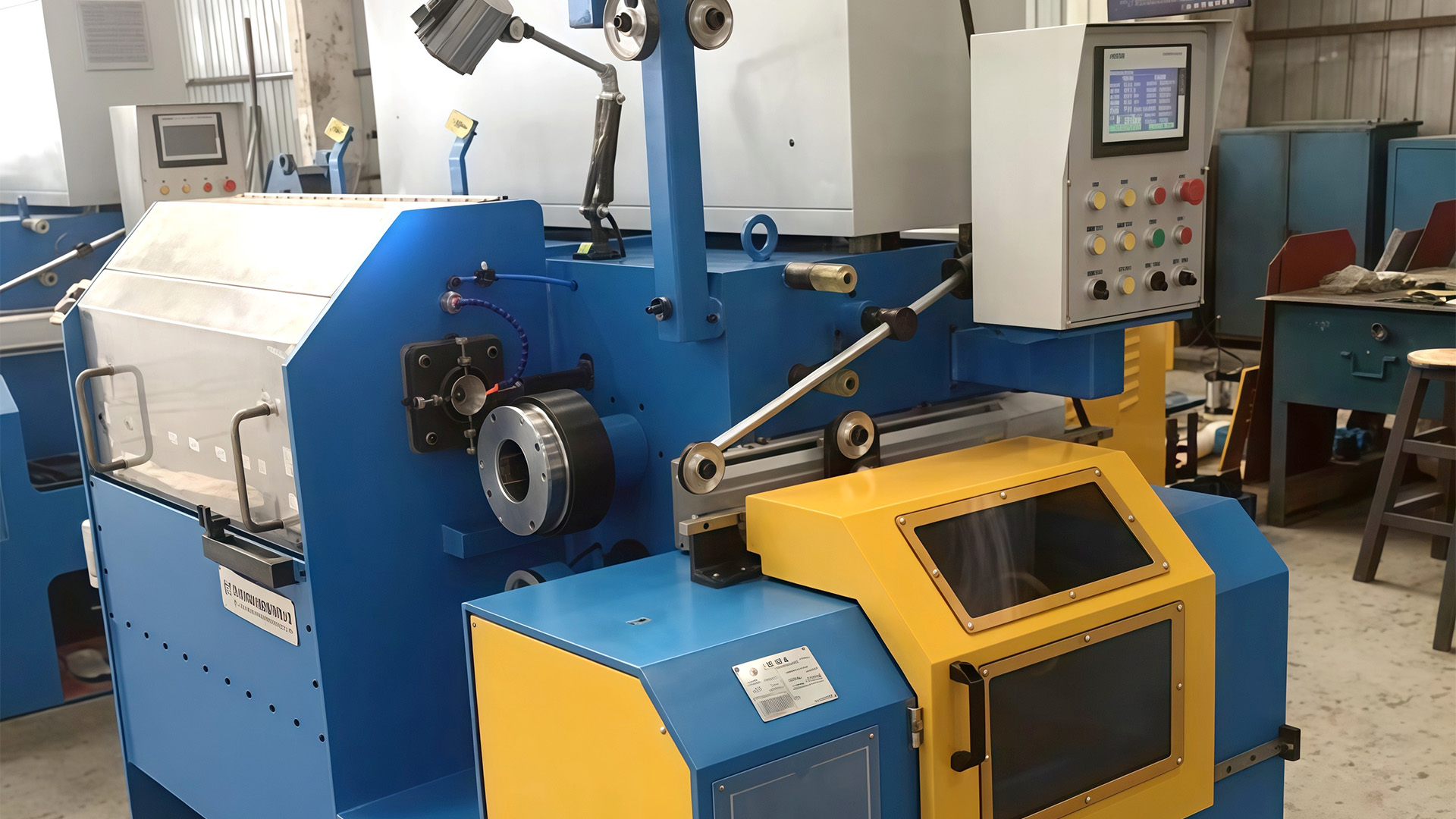
The conclusion is simple to state: for solid welding wire — carbon steel, stainless steel, or copper-coated grades — the welding wire drawing machine fixes the final diameter, surface condition, and mechanical consistency of the product. Its advantages translate into measurable outcomes: tighter diameter tolerance, a cleaner surface, higher line speed, and lower cost per ton shipped.
Why the Drawing Machine Sets the Ceiling for Welding Wire Quality
After the hot-rolled rod arrives, welding wire passes through scale removal, drawing, copper coating, and spooling. Drawing sets the final dimensions, tensile range, and surface state. The drafting schedule controls reduction per die, the capstan speed controls elongation, and the cooling system keeps the wire structure stable through the pass.
Drawing is the only step where the machine either locks in a good result or permanently stamps the wire with defects. If the line is stable, the coppering and spooling stations protect a good product; if it is not, no coating can rescue it.
Most invisible defects are born inside the drawing zone. A speed fluctuation, a worn die, a misaligned capstan, or a starved lubricant film can open a surface scratch that later cracks under the CO2 arc. That is why engineers evaluate a machine by three things: frame stiffness, drive smoothness, and repeatability of tension control.
Diameter Precision: The Advantage You Can Measure
The first advantage that separates a modern machine from an ageing one is consistency of diameter. A straight-line machine drives every capstan at a matched surface speed, so the wire is elongated with almost no slip. When each block has a servo or inverter drive, the ratio between blocks stays locked and the wire sees a constant reduction per die from the first metre to the last.
In shop-floor terms, the finished wire stays inside roughly ±0.01 mm on fine sizes. That is the difference between a spool that feeds smoothly all shift and one that forces the operator to change the contact tip or re-tighten the feed rolls several times.
Surface Quality That Keeps the Arc Stable
Surface finish matters more in welding wire than in almost any other drawn product. The wire is consumed at high speed through a small contact tip, and any scratch, scale pit, or lubricant residue disturbs electrical contact, raises spatter, or pulls oxides into the weld pool.
The machine contributes in three ways. Die alignment keeps the wire coaxial with the die bore and prevents one-sided wear. Lubrication prevents metal-to-metal contact and holds die temperature down. Cooling, normally through water-cooled capstans, stops the blue oxide staining that rejects finished lots.
Stainless grades such as ER308L and ER316L place even higher demands on the surface. Wet drawing is the standard route because the wire and dies are submerged in emulsion, giving uniform cooling and a bright finish.
Higher Line Speed and Longer Uptime
Speed is the most visible advantage, but the real gain comes from combining a high rated speed with low downtime. For welding wire below 1.2 mm, a well-configured water tank line can finish at 800–1,200 m/min. A straight-line dry machine on the coarse drafts of 5.5 mm rod runs slower but holds exceptionally stable tension.
What matters on the profit sheet is effective output per shift, not the nameplate speed. Stops for broken wire, die changes, and tangles remove the benefit of a fast motor. Modern machines attack downtime directly with quick-change die boxes, automatic tension compensation, and payoff and take-up stations that keep the line running while a full spool is lifted.
For a three-shift plant, the difference between 70% and 85% line availability is more than 20% additional yearly output at the same labour cost.
Lower Cost per Ton Through Die Life, Energy and Yield
Die costs are the easiest line item to compare. A machine that keeps the wire straight and the die aligned extends the life of tungsten carbide dies by a meaningful margin. In a multi-die pass schedule, that saving multiplies across every block, every shift, and every ton.
Energy is the second factor. Modern drives recover braking energy instead of bleeding it as heat, and they avoid the fixed losses of older throttled systems. On a three-shift line, a 10–15% energy saving per ton is a direct improvement to the operating budget.
Yield is the third factor and often the largest. Every broken wire, every poorly filled spool, and every reel of off-tolerance wire is lost margin. A stable machine raises conversion yield, and that number frequently justifies the investment more than the purchase price comparison.
Dry Straight-Line or Wet Water Tank: Matching the Machine to the Welding Grade
Every welding wire producer faces the same architectural decision: which drawing technology fits the product range.
Dry Straight-Line Drawing
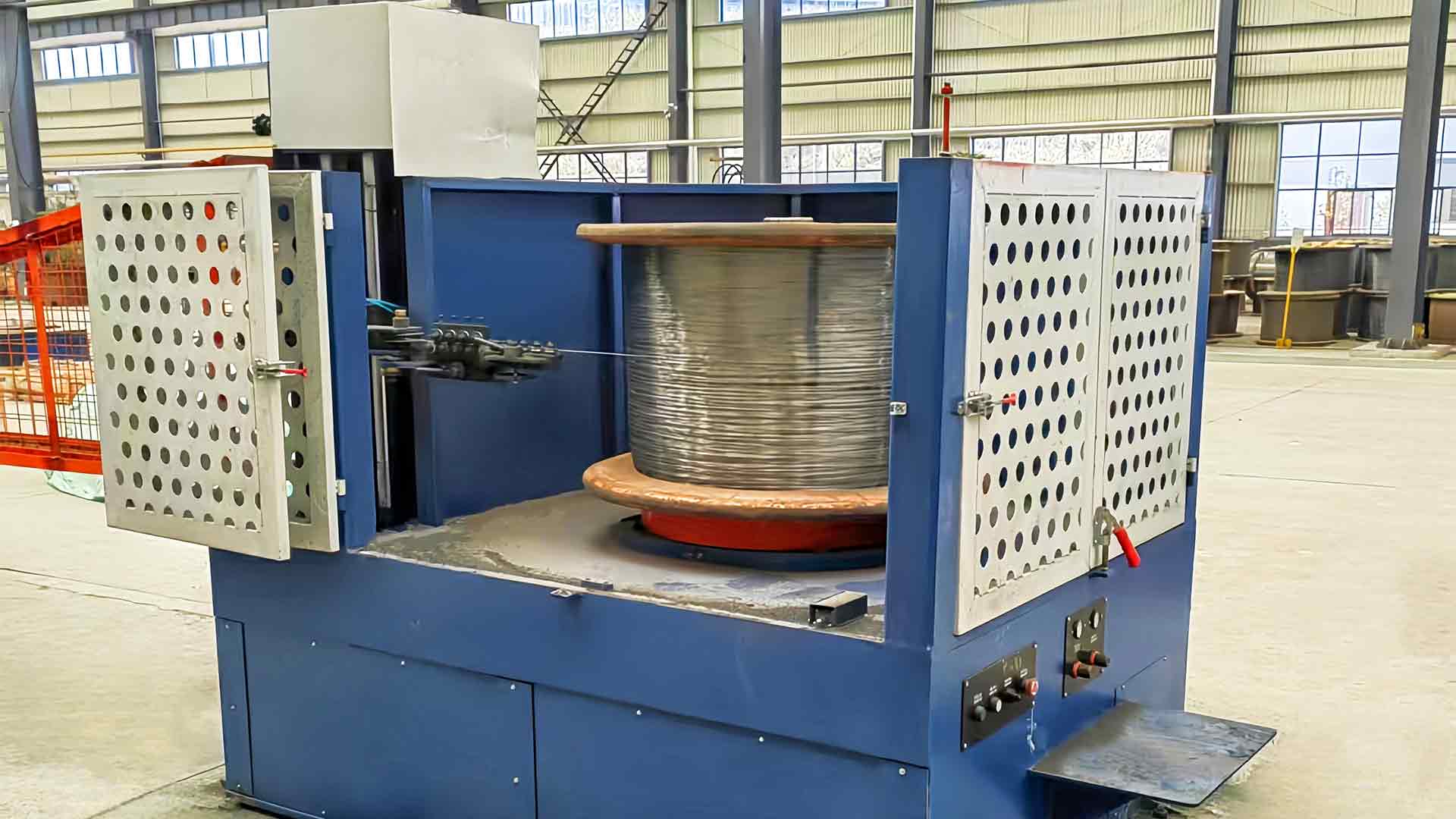
A straight-line machine pulls wire through die boxes mounted in a line, with each capstan driven to match the outgoing speed of the previous die. No slip means the reduction per die is exact, mechanical stress is lower, and tension stays precise through the pass. This architecture is a sensible first choice for low-carbon steel grades such as ER70S-6, especially for rough and intermediate drafts from 5.5 mm rod.
Wet Water Tank Drawing
Wet drawing submerges capstans and dies in a lubricating emulsion. Cooling is aggressive and the lubricant film is continuous, producing the bright surface that stainless steel and copper-coated fine MIG wires demand. This is the standard route for wire under 1.2 mm and for high-surface-quality grades.
| Aspect | Dry straight-line | Wet water tank |
|---|---|---|
| Lubrication | Powder soap applied at each die | Wire fully submerged in emulsion |
| Typical finishing size | 1.0–5.5 mm range | 0.4–1.6 mm fine wires |
| Surface finish | Good, depends on rod preparation | Excellent, bright and consistent |
| Cooling | Water-cooled capstans | Immersion cooling, higher speed headroom |
| Slip behaviour | No slip, speed ratio locked | Slip-type designs common on ultrafine sizes |
| Usual welding grades | ER70S-6 and similar carbon steels | ER308L / ER316L stainless, copper-coated MIG wire |
A common layout for a copper-coated MIG line is a dry straight-line machine for the rough drafts followed by a water tank machine for finishing. The operating principle is explained in this technical overview of straight wire drawing machines.
Practical Checks Before You Buy a Welding Wire Drawing Line
Buying on rated speed alone is the most common mistake in this product class. Start from the finished wire specification and work backwards through the drafting schedule.
- Define input and output: starting rod diameter, target wire diameter, steel grade, and the coating route planned downstream.
- Review the pass schedule: number of dies, reduction per die, and whether the capstan diameters fit the work-hardening curve of the grade.
- Verify cooling capacity against the intended line speed, especially water flow and temperature stability at each block.
- Check payoff and take-up matching, since fast spool changes matter as much as the drawing blocks.
- Ask about die box design: per-hole lubricant dosage, die holder access time, and how quickly an operator can change a die.
Ease of maintenance ranks near the top for repeat buyers. Quick access to capstans, visible lubrication lines, and per-die speed monitoring reduce repair time. Common faults and their diagnostics are collected in a practical guide on common problems in wire drawing machine operation.
The advantages of the welding wire drawing machine concentrate in four measurable areas: diameter consistency, surface integrity, line speed with uptime, and conversion cost. None of these can be added later by the coppering tank, the spooler, or the packaging station.
For plants planning a new line or replacing an ageing one, specify from the final certificate backwards and weight tolerance and availability higher than the brochure speed. Choose the architecture — straight-line, water tank, or a combination — based on the grades actually shipped. With that discipline, the drawing machine becomes the most reliable cost centre in the plant instead of the hidden source of rejects.