 English
 русский
 عربى

Wire Drawing Technology
Function of a High Carbon Steel Wire Drawing Machine
Reduction is only the headline. The real work happens across five linked functions, and on high carbon steel each one has a narrow tolerance before the wire breaks.
A 5.5 mm high carbon rod reaches the drawing line with a fine pearlitic structure and roughly 1,000 MPa of tensile strength. Nine dies later it leaves as 1.6 mm wire at close to 1,900 MPa. Nothing was added to the steel; every extra megapascal came from cold work. The machine's function is to apply that cold work fast enough to be profitable and gently enough that the wire survives it.
That is the short answer. The practical answer is a chain of functions: pay off the coil at controlled back tension, pull the wire through progressively smaller dies, carry heat away from die and capstan, keep every capstan at the correct speed so the wire is neither stretched nor slack, and lay the finished wire onto a spool or coil without damaging it. Skip one of those and the others stop mattering.
Per-pass reduction is the number that decides everything downstream: die life, capstan temperature, motor sizing and the package you can build at the end of the line.
The Core Function, Stated Plainly
The function of a high carbon steel wire drawing machine is to reduce the cross-sectional area of wire by pulling it through a series of dies, each slightly smaller than the last, while controlling tension, speed and temperature at every stage.
Two physical facts govern the whole process. First, the volume of metal passing any point per second stays constant, so as area falls, line speed must rise: a 20 percent area reduction at one capstan means the wire leaves that capstan about 25 percent faster than it entered. Second, cold work raises tensile strength and lowers elongation. High carbon grades work-harden steeply, which is exactly why they make good spring and strand wire, and exactly why the machine cannot take a large bite at any single die.
The mechanism itself is straightforward, and if you want the mechanical walkthrough first, our news pages cover how a drawing machine turns raw metal into fine wire. What matters commercially is that every function downstream inherits the mistakes made upstream.
Reduction Passes: Where the Diameter Is Won
Each die does one job: shave a controlled amount of area without generating a scratch, an oval cross-section or a surface crack. For high carbon wire, per-pass area reduction typically sits between 12 and 22 percent, with heavier passes at the front end and lighter finishing passes at the back. A die's approach angle, bearing length and carbide quality determine how the metal flows through it. A worn bearing shows up first as diameter drift of a few hundredths of a millimetre, then as a break.
This is where drive architecture matters. Straight-line machines that give every capstan its own motor, or that use servo direct drive, hold the speed ratio between adjacent capstans almost exactly, so the wire is genuinely drawn rather than dragged. Machines with a single motor and mechanical slip lose that precision as belts and pulleys wear, and the symptom is inconsistent elongation from the head of the spool to the tail.
Cooling and Lubrication: Where Breakage Is Prevented
Almost all of the mechanical work put into drawing converts to heat, and it appears exactly where the damage would: at the die bore and at the capstan surface. High carbon wire reaches die temperatures that break down ordinary lubricants, even at modest reduction. That is why the line needs water-cooled die holders, water-cooled capstans and a soap powder chosen for melting point and film strength rather than price per kilogram.
Lubrication failure is rarely dramatic. It looks like a slightly duller surface, then light scoring, then a die pulled out of tolerance weeks early. On high carbon wire the transition from acceptable to broken can happen inside a single coil, which is why coolant flow and soap consumption are worth checking every shift rather than every month.
Die quality is the other half of the equation. Carbide grade, bore polishing and casing concentricity decide how evenly the drawing load spreads across the contact arc, and therefore how long the die survives before diameter drifts.
Take-Up and Spooling: Where the Package Is Decided
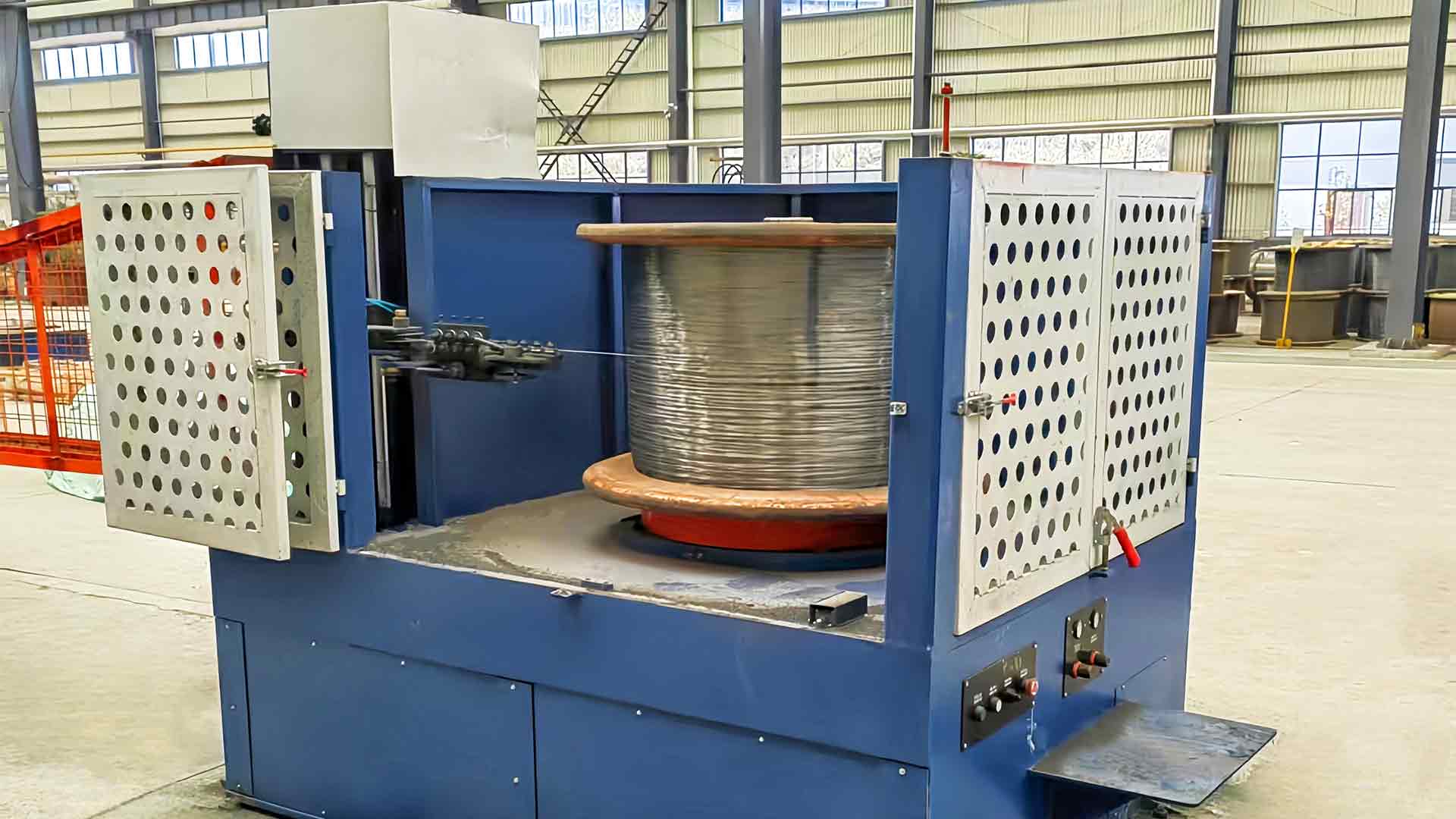
Everything upstream is wasted if the wire arrives on the spool with slack layers, crossed wraps or a built-in figure eight. Take-up has to hold a light, steady tension across the whole package, follow the drawing speed as the spool fills, and stop without jerking the wire. High carbon wire has little elongation left to absorb a snatch, so a poorly tuned dancer or accumulator usually costs you the entire spool.
Machine format changes how this is done. Spool take-up suits wire that feeds downstream lines automatically, while inverted and plum blossom winders produce coils for batch processing and shipping. On finer sizes, an elephant trunk winder gives a tighter, more even package with fewer manual interventions.
High Carbon versus Low Carbon: What Actually Changes
The machine looks similar to a low carbon line. The settings and supporting equipment do not.
| Parameter | Low Carbon (0.08 to 0.25 percent C) | High Carbon (0.60 to 1.00 percent C) |
|---|---|---|
| Typical incoming rod | 5.5 to 8.0 mm | 5.5 to 6.5 mm |
| Area reduction per pass | 20 to 30 percent | 12 to 22 percent |
| Passes to reach final size | 3 to 6 | 8 to 14 |
| Upstream preparation | Usually none beyond descaling | Patenting to fine pearlite |
| Cooling demand | Moderate | Continuous, water-cooled die holders and capstans |
| Tensile strength change | Modest rise | About 1,000 MPa to 1,800 or 2,200 MPa |
| Cost of a break | Short stoppage, wire rethreaded | Spool scrapped or wire cut and welded off |
Specification Points Worth Writing Down
When two machines quote the same die count and the same top speed, the differences sit in the details. Ask for these in writing:
- Capstan cooling method, and whether water-cooled die holders are standard or an option
- Number of capstans, individual motor drive or servo direct drive, and the guaranteed speed ratio accuracy between them
- Rated inlet rod diameter and the reduction schedule the machine was designed around, not a generic maximum
- Take-up type, maximum package weight and tension range, because a 500 kg package and a 1,250 kg package are different projects
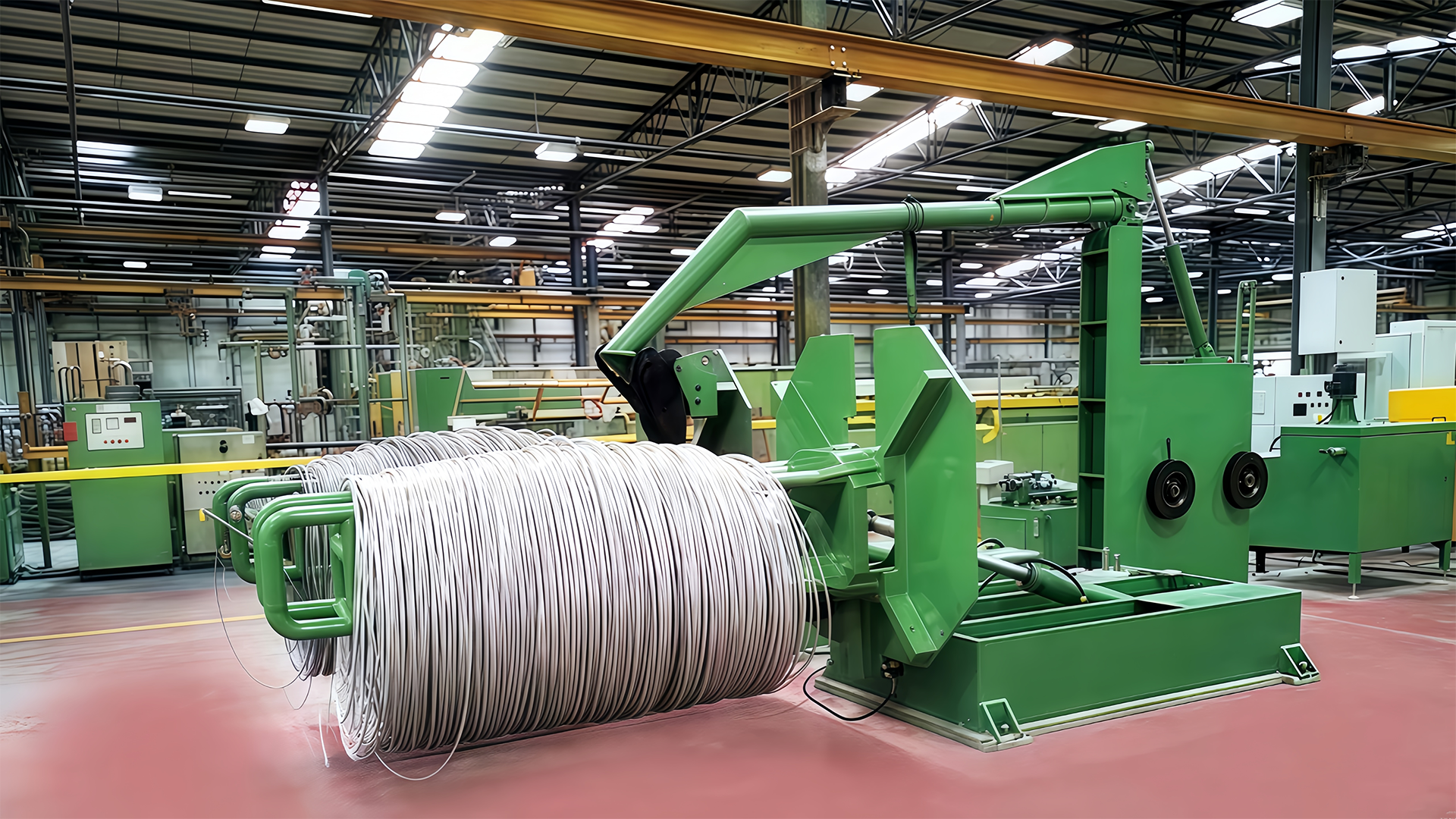
- Payoff compatibility with the coil weight you actually buy, including whether a tension payoff stand or a flip-type overhead payoff is required
- Spare parts position on dies, capstan rings and lubricating powder, since a high carbon line consumes all three faster than a low carbon line
Buyers comparing straight-line wire drawing machines should ask each supplier to draw a reduction schedule against their own incoming rod and finished diameter. A schedule built for someone else's product is not evidence of anything.
Where the Wire Goes After Drawing
The functions above are set by the product, not by the machine catalogue. Common high carbon destinations include:
- Spring wire for suspension, mattress and industrial springs, usually drawn from 0.60 to 0.80 percent carbon grades
- Prestressed concrete strand and PC wire, where consistent tensile strength along the length matters more than the last 50 MPa
- Tire bead, hose and belt reinforcement wire, drawn to fine sizes with tight diameter tolerance
- Rope and cable wire, where surface condition decides fatigue life more than tensile grade does
- Fencing and general-purpose high carbon wire, where tonnes per shift outweigh surface finish
Warning Signs on the Shop Floor
A high carbon line usually announces a problem before it fails. Diameter drift with no speed change points to die wear. A rising capstan temperature at normal output points to the cooling circuit, not to the steel. Elongation scatter between the head and tail of a spool points to tension control. Reading these three signals correctly is most of what separates a stable line from a reactive one.
Never compensate for a worn die by raising take-up tension or line speed. Both increase the load on the next die and shorten its life in a chain reaction that ends with a break at the least convenient moment.
Record per-pass reduction, die change intervals and capstan temperatures every shift. Within a few weeks you will have a baseline that makes deviations visible hours before a spool is lost.
Function, in the end, is not a list of features on a specification sheet. A high carbon steel wire drawing machine earns its place on the line by holding a reduction schedule steady for thousands of tonnes: feeding at even tension, cooling die and capstan, keeping every capstan in step, and delivering a package the next process can use without rework. Machines that do this are quiet, predictable and easy to ignore. Machines that do not will show up in the scrap report long before they appear in the downtime report.