 English
 русский
 عربى
عربى

Manufacturing Insight — Pay-Off Systems
Can a Pay-Off Rack Handle Multiple Spools Simultaneously, and How Does That Affect Line Speed?
A direct answer, and the engineering nuance behind it — how tension, spindle count, and synchronization quietly shape everything downstream.
Direct Answer: Yes, a Pay-Off Rack Can Handle Multiple Spools
A pay-off rack can absolutely handle multiple spools simultaneously, and this is one of the most common configurations used in wire, cable, and hose manufacturing today. Multi-spool pay-off racks, sometimes built as a double-spindle or multi-tier pay off stand, allow two or more reels to unwind at the same time, feeding several strands into a single downstream process such as bunching, twisting, braiding, or extrusion. However, running multiple spools does affect line speed, tension consistency, and overall throughput in ways that operators need to understand before configuring their production setup.
pay-off rack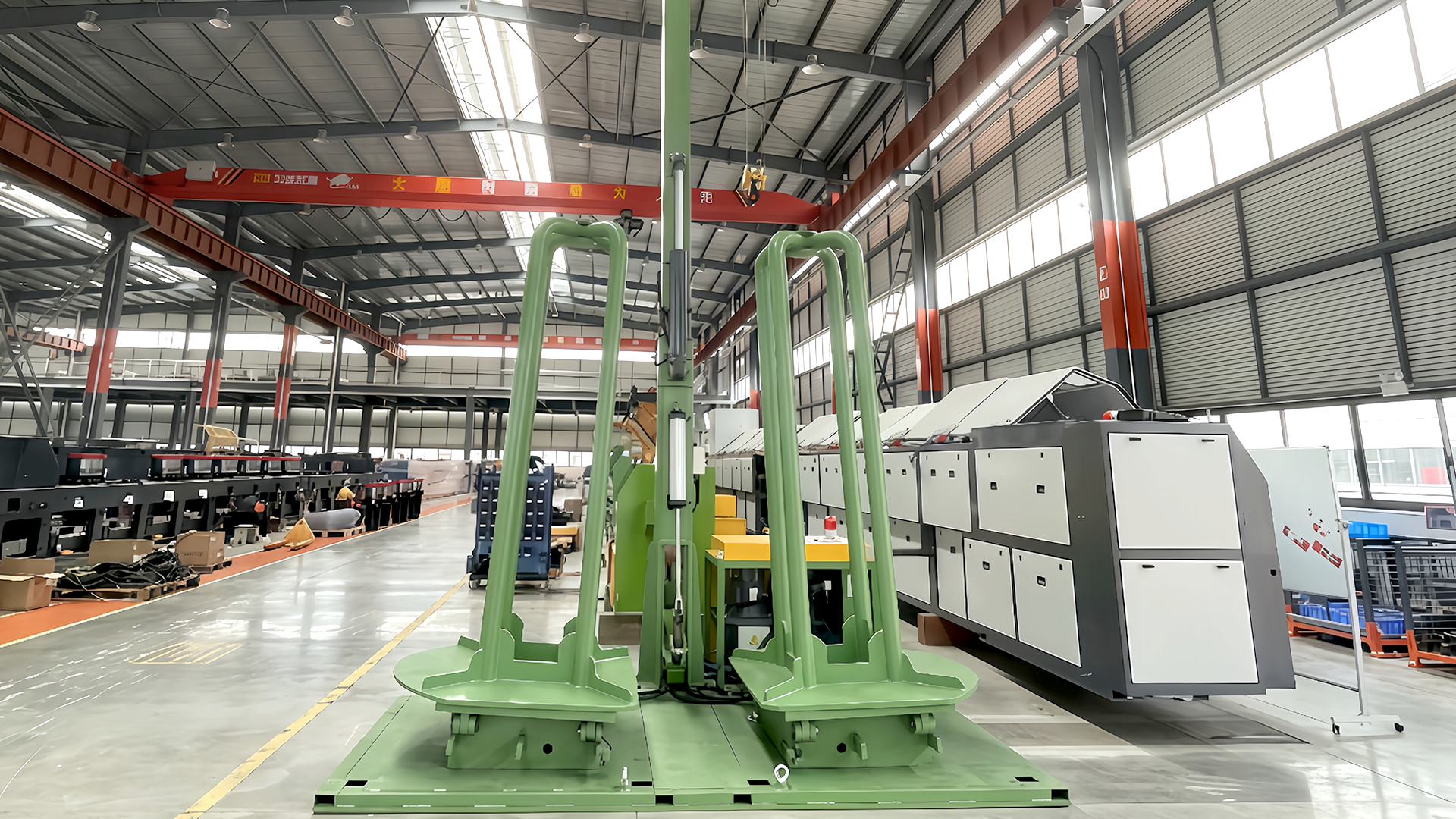
In general, adding more spools to a single pay-off rack increases the total mechanical load, the complexity of tension synchronization, and the risk of speed mismatches between spindles. When properly engineered, a multi-spool pay-off rack can maintain line speeds within 5-10% of a single-spool setup, but poorly matched components or inadequate braking systems can cause speed reductions of 20% or more due to constant stopping for tangle correction or tension adjustment.
Why Manufacturers Use Multi-Spool Pay-Off Racks
Multi-spool configurations exist because many finished products require more than one strand of material fed into the process at once. A twisted pair cable, for example, needs two conductors unwound in perfect synchronization. A braided hose reinforcement layer might need six, eight, or even sixteen spools of wire or fiber feeding simultaneously into a braiding head. Without a properly designed pay-off rack, this kind of multi-strand production simply would not be possible on a continuous basis.
Common Applications
- Twisted pair and multi-conductor cable manufacturing
- Wire braiding for shielded cables and reinforced hoses
- Rope and cordage production using multiple fiber strands
- Bundling operations for automotive wiring harnesses
- Fiber optic cable assembly requiring multiple buffer tubes
In each of these cases, a single pay-off rack replaces what would otherwise require several standalone unwinding units, saving floor space and reducing the number of operators needed to monitor the line.
"The bottleneck is rarely the machine — it's the one spool that doesn't match the others."
Types of Multi-Spool Pay-Off Rack Configurations
Not all multi-spool systems are built the same way. The configuration chosen depends heavily on the number of strands required, the diameter and weight of each spool, and the speed at which the downstream machine operates.
Side-by-Side Spindle Racks
This is the simplest form of multi-spool pay-off rack, where two or more spindles are mounted horizontally next to each other. Each spindle rotates independently with its own braking mechanism, and the strands are guided through separate tensioners before merging at a common feed point. This design works well for low to moderate speed applications, typically under 150 meters per minute.
Vertical Multi-Tier Pay-Off Stands
For operations requiring a larger number of spools, a vertical multi-tier pay off stand stacks spindles in a tower-like arrangement. This saves significant floor space compared to a side-by-side layout and is commonly used in braiding machines where eight, sixteen, or even twenty-four spools need to feed into a single braiding head simultaneously.
Rotating Drum or Creel-Style Racks
Creel systems house dozens of spools in a fixed frame, with each spool feeding a separate strand outward. These are typically used in textile-adjacent wire operations or in cable armoring processes where a large number of thin wires must be fed in parallel with minimal tension variation.
How Multiple Spools Affect Line Speed
The relationship between spool count and line speed is not linear, but it is significant. Each additional spool introduces another potential point of failure, another tension curve to manage, and another source of mechanical inertia that must be overcome during acceleration and deceleration.
When spools are mismatched in diameter, weight, or braking resistance, the strand from the "slowest" spool becomes the bottleneck for the entire line. Operators often reduce overall line speed by 10% to 25% simply to accommodate the least consistent spool in a multi-spool setup, even if the other spools could technically run faster.
| Number of Spools | Typical Line Speed Impact | Common Application |
|---|---|---|
| 1 Spool | Baseline (100%) | Single-conductor wire drawing |
| 2 Spools | 90-95% of baseline | Twisted pair cable |
| 4-8 Spools | 75-90% of baseline | Small braiding operations |
| 16+ Spools | 60-80% of baseline | Heavy braided shielding, armoring |
These figures are general industry estimates and will vary depending on the quality of the tensioning system, the material being unwound, and the precision of spindle alignment. Facilities that invest in matched-tension spindles and automated braking often see far smaller speed penalties, sometimes keeping losses under 5% even with eight or more spools running at once.
Tension Synchronization Across Multiple Spools
Tension control is the single most important factor in making a multi-spool pay-off rack function reliably. If one spool feeds material too loosely while another feeds too tightly, the resulting product can suffer from inconsistent diameter, uneven twist geometry, or outright breakage.
Mechanical Braking Systems
Simple friction brakes or magnetic particle brakes are applied to each spindle individually. These are cost-effective and work well for lower-speed lines, but they require regular manual calibration to keep tension consistent across all spools.
Dancer Arm Systems
A dancer arm is a spring-loaded or pneumatic arm that automatically adjusts braking pressure based on real-time tension readings. In multi-spool setups, each strand typically gets its own dancer arm, allowing the pay-off rack to self-correct minor tension fluctuations without operator intervention.
Servo-Driven Active Pay-Off Racks
For high-speed or high-precision applications, servo motors actively drive each spindle rather than relying purely on passive braking. This is the most expensive option but delivers the most consistent tension across all spools, often allowing multi-spool lines to run at speeds within 3-5% of single-spool equivalents.
Practical Considerations Before Adding More Spools
Before scaling up a pay-off rack to accommodate additional spools, several practical factors need to be evaluated to avoid costly downtime or product defects.
- Confirm that the spindle bearings and frame can support the combined weight of all loaded spools without deflection.
- Verify that each spool has matching or near-matching diameter and material type to reduce tension mismatch.
- Check that the guide eyes and tensioners are spaced correctly to prevent strand crossing or abrasion.
- Assess whether the downstream machine's take-up speed can actually use the additional strands without becoming the new bottleneck.
- Plan for spool changeover time, since more spools mean more frequent individual replacements even if the overall run length increases.
Facilities that skip this evaluation often find that a newly expanded pay-off rack actually produces lower net output than expected, because unplanned stoppages for tangle correction or spool replacement offset any theoretical throughput gains.
Maintenance Implications of Multi-Spool Systems
More spools mean more moving parts, and more moving parts mean a proportionally higher maintenance burden. A single-spool pay off stand might only require bearing lubrication and brake pad inspection every few months, but a multi-spool rack running continuously can require weekly checks on tensioners, guide rollers, and spindle alignment.
Operators managing multi-spool racks should keep a maintenance log for each individual spindle position, since wear patterns often differ across the rack. Spindles positioned closer to the drive mechanism, for instance, may experience more vibration-related wear than those at the outer edges of the frame.
Balancing Throughput Gains Against Complexity
The core trade-off with multi-spool pay-off racks is straightforward: more spools mean more strands processed per cycle, but also more complexity, more potential points of failure, and typically a modest reduction in achievable line speed. For most manufacturers, the net effect is still positive, because feeding four or eight strands at 85% of single-spool speed produces far more finished product per hour than running four or eight separate single-spool lines at full speed with additional labor and floor space requirements.
The decision to expand a pay-off rack to handle more spools should always be weighed against the specific product being manufactured, the tolerance for tension variation in that product, and the capital available to invest in higher-precision tensioning equipment. A well-designed multi-spool pay off stand, paired with active tension control, can deliver production efficiency gains of 30% or more compared to running multiple single-spool lines separately, even after accounting for the modest per-strand speed reduction.
Key Takeaways
- Multi-spool pay-off racks are standard equipment for twisted, braided, and bundled cable products.
- Line speed typically drops between 5% and 25% depending on spool count and tension control quality.
- Servo-driven active systems minimize speed loss but come at a higher upfront cost.
- Matching spool size and material across all positions reduces tension mismatch and downtime.
- Despite the speed trade-off, multi-spool configurations generally deliver higher overall production efficiency than running multiple single-spool lines.