 English
 русский
 عربى

Field Notes · Wire Drawing
The Quiet Discipline of a Fully Automatic Straight Line Wire Drawing Machine
A line that pulls 5.5 mm rod down to 1.0 mm with nobody standing over it is not a miracle of automation. It is a long chain of small agreements between motor, die, lubricant and operator, and every one of them has to hold at every pass.
Walk through a wire mill early in the morning and you can hear the difference. A semi-automatic line announces itself: footsteps, the clang of a spool change, a pause while a tension arm settles. A fully automatic straight line machine sounds almost boring. The payoff turns. The capstans hum in step. The take-up winds a spool that will be full in forty minutes, and then it swaps itself out. Nothing dramatic happens, which is precisely the point.
We have been building wire drawing equipment in Wuxi since 2010, with roots in this trade stretching back considerably further, and the lesson has not changed. Automation does not remove skill from the process. It moves skill out of the operator's hands and into the design of the line. The rest of this article is about what that relocation actually involves.
What "Fully Automatic" Really Means
The phrase gets used loosely in equipment catalogues. On a straight line machine, it should mean something specific: the line manages its own tension, its own speed ratio and its own stoppages, from the first pass to the finished spool.
That usually comes down to four engineering decisions. Each capstan gets its own drive rather than sharing a single shaft, so the speed ratio between passes can be trimmed electronically instead of being fixed by gear geometry. Tension between passes is measured and corrected continuously, not set once and hoped for. Recipes are stored, so changing from one product to another is a screen and a die change rather than a hand-written pass schedule. And the line knows how to stop: on a wire break it halts cleanly and tells you which die position failed.
- Independent drives on each capstan, with closed-loop tension control between passes.
- Stored recipes for each product, so repeat orders run identically.
- Synchronised payoff and take-up, so line tension is established once and held.
- Fault memory, which turns a break from an argument into a data point.
The payoff is not glamorous. It is fewer breaks on fine diameters, better concentricity, less scrap at the start of a spool, and an operator who spends the shift watching quality instead of watching the machine.
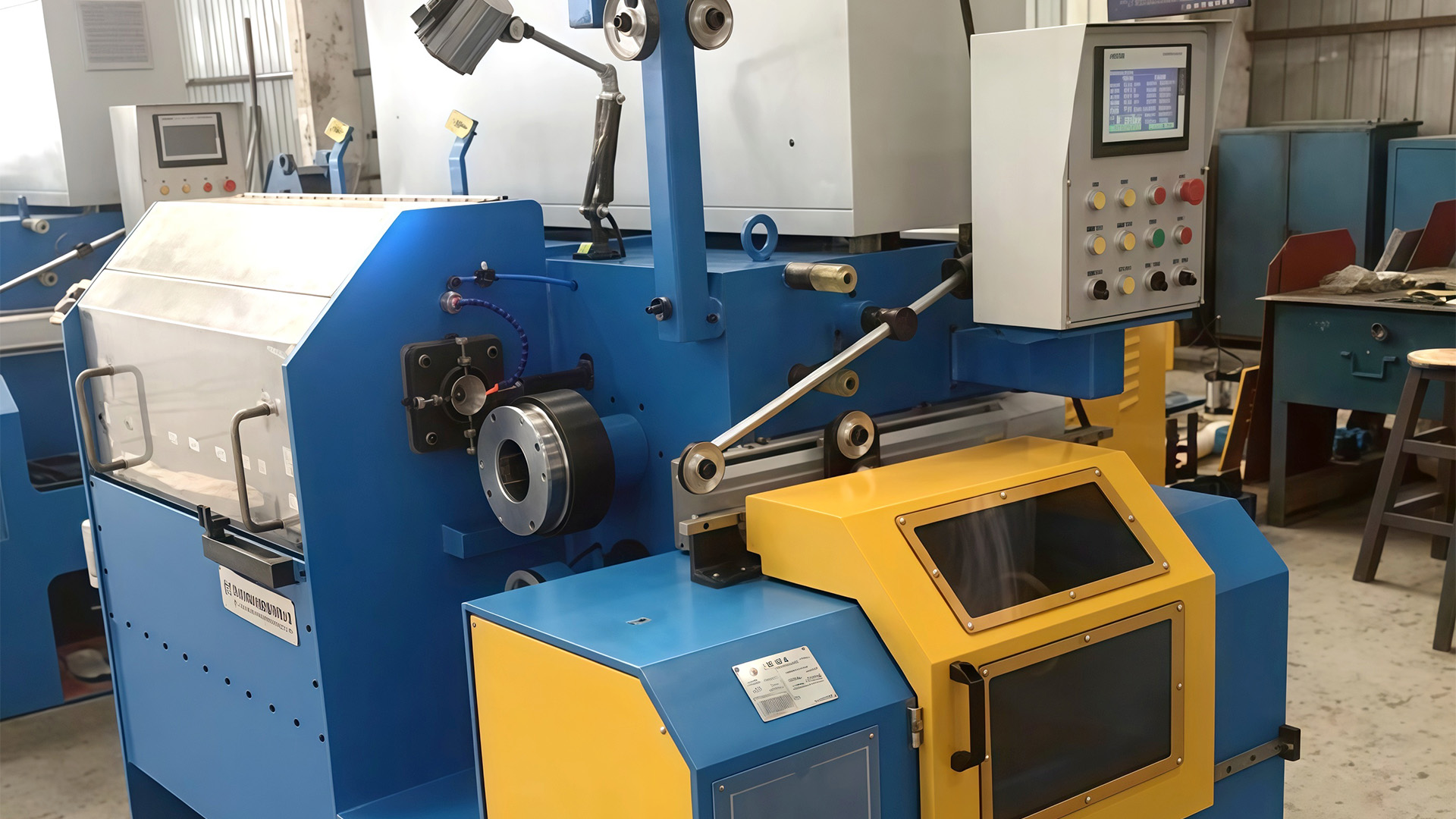
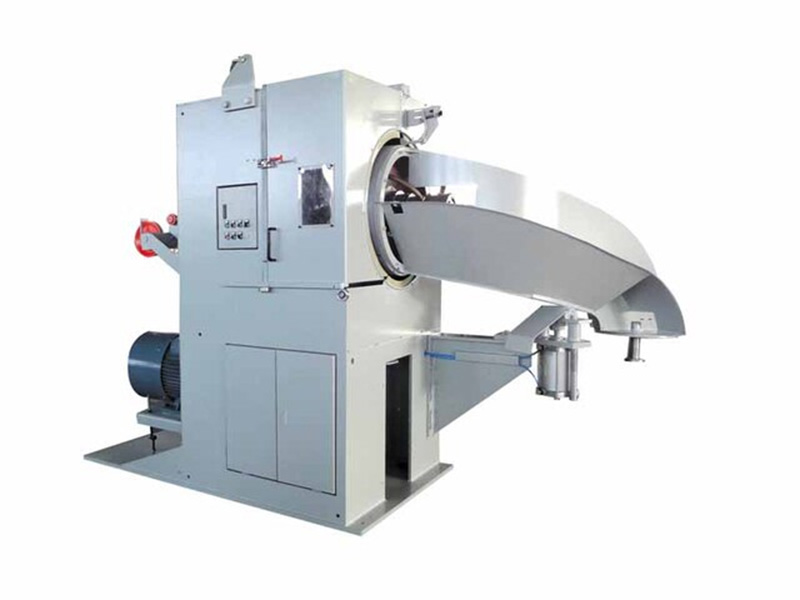 Integrated Direct Wire Drawing Machine SystemCompact integrated system combines pay-off, take-up, dies, lubrication, tension control and pulling to draw carbon steel, stainless, brass and copper wire with less manual handling.View Product →
If you want the mechanical background first, our engineers wrote a plain-language explanation of how a single straight line drawing pass actually works, from die approach angle to capstan grip. It is worth ten minutes before any specification conversation.
Anatomy of a Line: Payoff, Drawing, Take-Up
A drawing line is usually described by its main machine, but most of the trouble lives at the edges. The payoff decides whether the rod arrives calm or fighting. The take-up decides whether the finished wire leaves tidy or tangled. In between, the drawing section does the work that everyone talks about.
| Stage | What it does | Where lines get lost |
|---|---|---|
| Payoff | Feeds rod at low, controlled tension | Tangling, brake drag, poor coil geometry |
| Drawing | Reduces diameter pass by pass through carbide dies | Uneven reduction, worn dies, capstan slip |
| Lubrication and cooling | Holds die and capstan temperature steady | Dry dies, blocked nozzles, wrong lubricant grade |
| Take-up | Winds finished wire at matched tension | Traverse faults, soft spools, drifting tension |
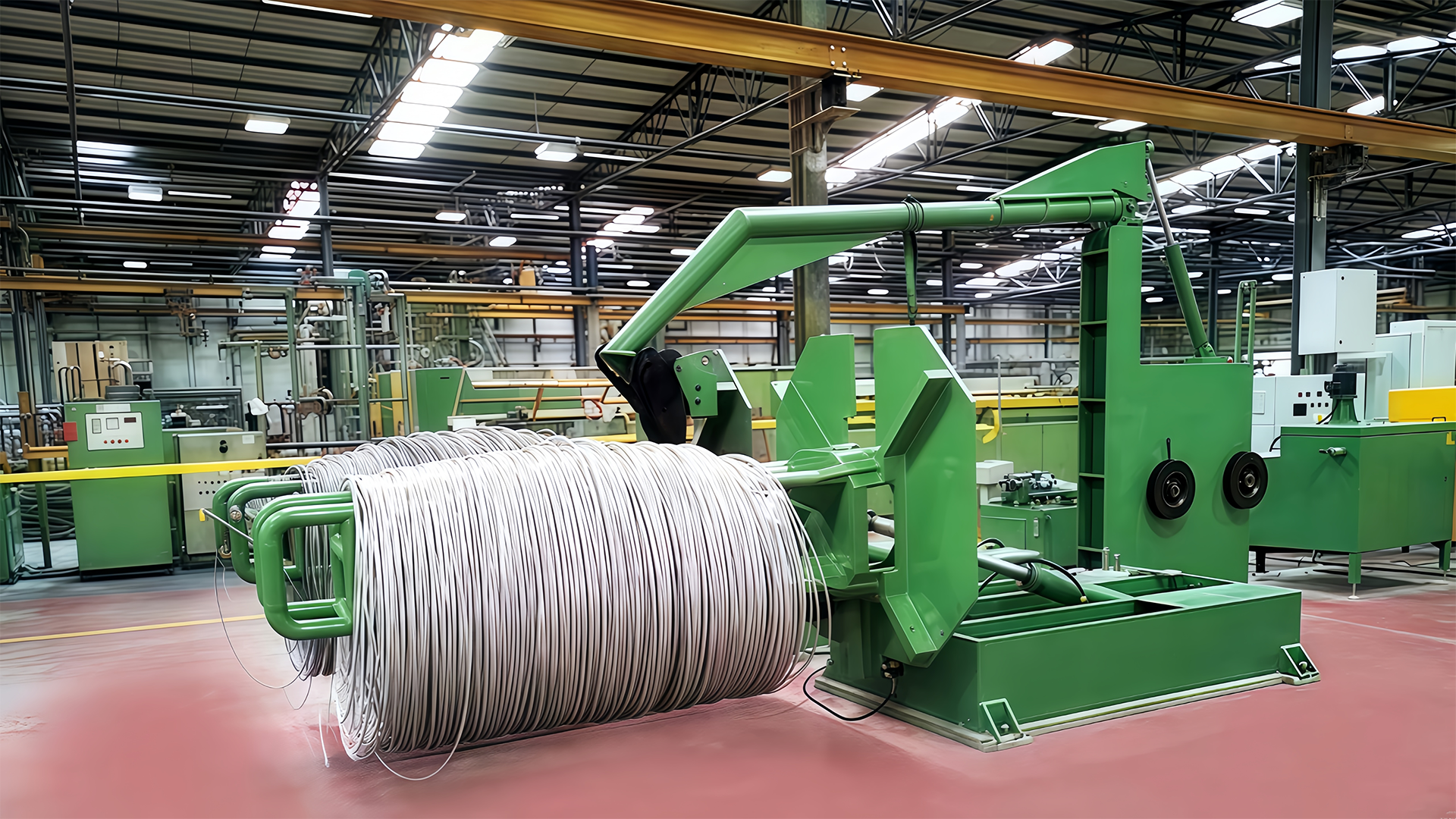
On floor space, the payoff is often the constraint. A conventional overhead frame needs headroom and a clear swing; a flip-type overhead payoff folds the coil into position instead, which matters when the line sits in an existing bay rather than a new building. Either way, the design question is the same: can the rod enter the first die with steady, low tension and no lateral pull?
Matching the Machine to the Material
The material chooses the machine, not the other way round. This is the single most common misunderstanding we meet in enquiries, and it is worth settling before anything else is discussed.
Low carbon steel: the working backbone
Bulk low carbon wire for nails, mesh, fencing and binding is dry drawn, because the surface can carry dry lubricant into the die and the economics reward speed and long runs. A well-matched machine of this type will hold a stable pass schedule for hours, and the operator's main job becomes die inspection and spool logistics rather than intervention.
Low Carbon Steel Straight Wire Drawing MachineStraight-line machine for dry drawing low carbon steel wire, designed to reduce diameter while maintaining strength and consistency for mesh, fencing and binding applications.View Product →
Stainless and other sensitive surfaces
Stainless, and much of the fine wire used in weaving or cable work, is better served by wet drawing in a water tank machine, where the die and wire are fully immersed. The liquid carries heat away, keeps the surface clean, and makes the finer passes realistic. Trying to dry-draw these materials usually shows up as scratching, die wear, or an unexplained rash of breaks in the last two passes.
Coated and composite wire
Aluminium-clad steel and similar composite conductors need gentler reductions and careful die geometry, because the cladding is softer than the core and deforms differently. The pass schedule has to protect the outer layer while still reducing the core.
A pause worth taking. If a supplier quotes a dry straight line machine for stainless without asking about surface finish, lubricant and final application, the quotation is a price, not an engineering answer. Ask what happens in pass four.
Our own straight line wire drawing range spans mesh wire, low carbon, aluminium-clad and heavy dry applications, precisely because the same frame does not suit every material.
The Numbers Worth Arguing About
Most of a drawing line's behaviour is decided on paper, in the pass schedule. When a customer sends us a specification, these are the figures we work through together before a single component is chosen.
- Inlet and outlet diameter, plus the tolerance band that actually matters downstream.
- Reduction per pass, typically in the region of eighteen to twenty-five percent area reduction for low carbon work, adjusted for the material's ductility.
- Die sequence and approach angle, including carbide grade and expected die life between polishings.
- Cooling capacity, sized for the worst summer afternoon rather than the average day.
- Motor sizing and speed range, with the real production speed, not the brochure maximum.
- Spool format and handling, because a fast machine that stops every twenty minutes for a spool change is not fast.
There is a saying on our shop floor: a drawing line rarely fails at full speed. It fails at the changeover, when everyone is in a hurry.
That is why we treat the changeover sequence as a design feature. Traverse pitch, spool clamping, wire clamping and the brake ramp all determine whether a spool change takes forty seconds or four minutes, and that difference compounds across three shifts.
Commissioning and the Long Middle of Ownership
The interesting part of ownership starts after the machine is bolted down. Alignment, foundation flatness, die break-in and operator training decide whether the first month is a smooth ramp or a series of negotiations with the scrap bin.
- Alignment first. A line is only as straight as its reference, and a small height error at the payoff becomes a lateral pull at the first die.
- Break in the dies. New dies need a gentle start; running a fresh set at full reduction is an expensive habit.
- Train on the recipe screen, not just the buttons. Operators who understand why a ratio changed make better decisions at three in the morning.
- Keep the consumables honest. Dies, lubricant powder and cooling water quality are the three items that quietly set the maintenance calendar.
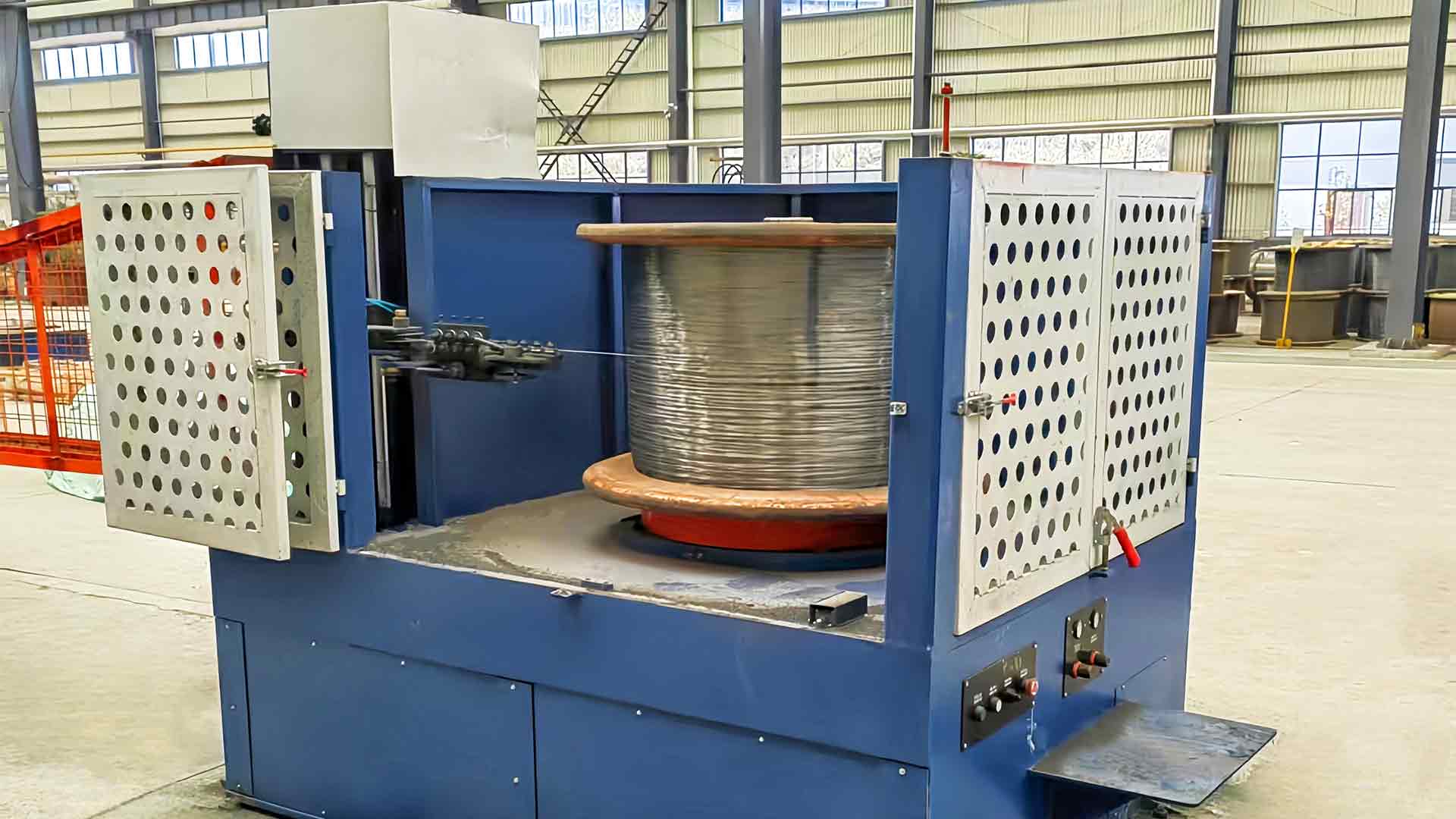
Spool Take-Up Machine for Wire Drawing LinesPLC-controlled take-up winds drawn copper, aluminum, steel and alloy wire onto varied spool sizes, with adjustable speed and tension to protect wire shape during storage.View Product →
Because our workshop is ISO 9001 certified and our machines carry CE marking for European customers, the documentation side of commissioning tends to be straightforward. Over fifteen years we have shipped to more than forty countries, and the questions at handover are remarkably similar whether the line lands in Jiangsu or in Eastern Europe.
What helps us quote accurately. Material and grade, inlet and outlet diameter, target line speed, spool type and weight, and the available power supply. With those five answers we can propose a pass schedule instead of a guess.
A fully automatic straight line wire drawing machine is best understood as a piece of industrial choreography. The individual movements are simple: pull, reduce, cool, wind. What makes it automatic is that all of them hold their timing, hour after hour, spool after spool, without a person correcting them.
That is also why we are cautious about promising "full automation" as a headline. The honest version is a line whose tension, ratio and stoppages are engineered closely enough that an operator can supervise three passes ahead instead of one pass behind. When that happens, the machine stops being the centre of attention, and the wire becomes the subject again.
If you are working through a specification, send us the wire you intend to draw and the wire you need to end up with. We will tell you where the difficulties are likely to sit, and which of them the machine can solve on its own.